
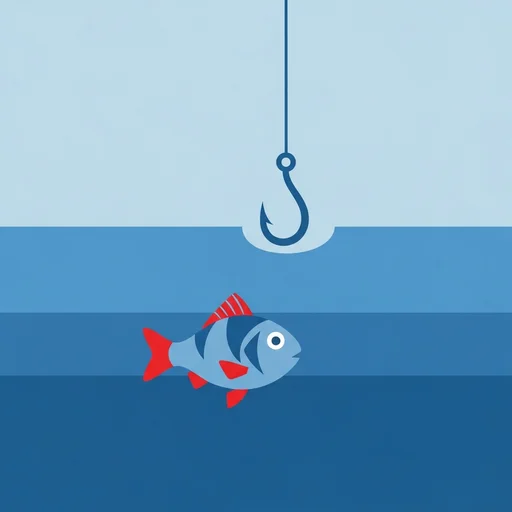
The Tale of the Curious Perch
In a quiet, reed-fringed lake, a young perch with bright, striped sides and prickly fins wriggled among the water lilies. He was the liveliest fish of his shoal and, everyone said, the most curious. When dragonflies skated on the glassy surface and swallows stitched the sky with their wings, he stared up, wondering what lay beyond the lake’s green walls.
“Mother,” he asked one sunlit morning, “is the world very large?”
“Larger than a fish can swim,” said Mother Perch, circling him with a watchful eye. “There are nets that tangle, hooks that glitter, and wheels that churn the water to foam. Curiosity must swim with caution.”
The little perch listened, but his eyes still shone. The brook that slipped out of the lake called to him, chuckling over pebbles as if it knew grand secrets. One day, when the shoal hid in the reeds from a shadowing pike, the perch’s quick heart thumped with a different kind of bravery. “I will only look,” he told himself. “Just to see.”
He slipped into the brook. At once, the current took hold, tugging him along mossy stones and under a bridge of bent grasses. A water strider zipped beside him like a tiny boat. “Turn back, little fins!” clacked a crayfish from under a rock, waving its claws. “The stream grows swift!”
“I only want to see,” said the perch, and on he went.
Soon the brook rushed faster and flung him into a wide millpond, where a wooden wheel turned, rumbling and dripping. The water swirled and sucked. The perch flattened himself against the flow, but the current nosed him toward the sluice. “Keep low!” boomed an old eel, sliding past. “And mind the wheel—its paddles bite.”
With a shiver and a dart, the perch dived. The water shot him through the dark chute and out again in a roar of bubbles. He tumbled, bumped a floating stick, and came up sputtering—if a fish can sputter—with his fins all a-tingle. He laughed inside his fishy heart. “So that is a mill!”
Below the mill, the stream wandered past a village. Cows came to drink. Their soft noses stirred the bank, and their warm breath made ripples. Washing lines fluttered in a yard. Geese waddled down to hiss at their own reflections. The perch watched everything, eyes round with wonder.
Children appeared on the bridge, peering into the clear water. “I see one!” cried a boy, and down whisked a line with a worm as rosy as a berry. The worm twitched. How bright it looked! How easy it would be to swallow!
“Glitter can be danger,” the perch remembered, and flicked his tail. The hook pricked the water where he had been. He hid under a broken crock until the shadows of the children drifted away, and then he slipped onward.
The stream widened once more into a calm pond in a grand garden. White swans sailed like small boats, and willow branches trailed the surface like hair. Beyond the pond rose a big house with many windows that caught the sun. People strolled on the path; a little girl in a blue dress scattered crumbs to the ducks and pointed whenever a fish turned up a silver side.
“How marvelous,” breathed the perch. He circled the lilies and nibbled a few drifting crumbs, though bread was not exactly to his taste. He had never seen such a place.
But where people walk, hooks often follow. A farm boy sat on the bank with a rod. He had a hat too big for his head, and the concentration of a cat. His line dangled just where the perch liked to explore. On the end of the line gleamed not a worm but something bright—bright as a beetle’s back—tied to a small, sharp curve of metal.
The perch’s heart beat faster. “Just a taste,” he thought. He edged closer. The bright thing flashed again, dancing just so. For a moment—only a moment—he forgot mills and eels and his mother’s warning. He opened his mouth.
The pain came like lightning. The hook caught. The boy jerked the rod, and the world went up—up into fierce, thin air. The perch flailed, gasping, his body heavy outside the water. He saw the blue dress blur into view. “Oh!” cried the little girl. “What a pretty perch!”
The boy dropped him into a wooden pail brimming with pond water. “For the cook,” the boy said, proud as a king.
In the dim kitchen, where herbs hung from beams and a clock ticked, the cook peered into the pail. “A fine fish for supper,” she said, wiping her hands on her apron. The perch hovered, aching and afraid, his gills working hard.
The little girl touched the rim of the pail. “Must we?” she asked softly. “See how his sides shine. He looks frightened.”
“Fish don’t feel as we do,” said the cook, but her voice gentled a little. “That is their way, and we must eat.” She reached for a net.
The little girl’s brow furrowed. She thought of the swans on the pond and the dragonflies on summer days and the way the perch had turned his bright eye toward her. “Papa says to be kind, when we can,” she said. “Please, could we let just this one go?”
The cook paused, her hands still. The kitchen clock ticked again. In the end, she sighed. “Just this once, then. Off you run.”
So the little girl lifted the pail and carried it carefully down the garden path. The water slopped against the wooden sides, and the perch kept himself very still, as if stillness could make the pail lighter. At the pond’s edge she knelt. “Swim home, curious one,” she whispered, and tipped the pail.
Cool water closed over the perch. He darted—oh, how he darted!—under lilies and past roots, into the stream that slid away toward the mill. The way back was harder, for the water now flowed against him, but his fear made him strong. He rested in the shadows, then swam, rested and swam, slipping behind stones, threading through grass, beating his tail like a drum.
At the mill he waited for the wheel to lift and the current to slacken, then shot for the side where old stones made a quiet eddy. The eel was gone, but the perch remembered his warning and kept low. At last he came to the brook mouth where it kissed the lake, and he burst through, home at last in the soft, green-gleaming water he knew.
Mother Perch found him trembling under a lily pad. “So,” she said, and her voice was both stern and warm, “you have seen the world.”
The little perch drooped his fins. “I saw swans and a great house, and I flew into air, and a kind child saved me,” he said. “I forgot your warning for a moment, and it nearly cost me everything.”
Mother Perch smoothed the water along his back with her tail. “Curiosity can be a bright lantern,” she said, “but hold it carefully. Let it lead your eyes before it leads your mouth.”
The little perch nodded. He nestled among his own shoal again, and though his eyes still shone when dragonflies skated and the brook chuckled secrets, he swam with wiser strokes. Sometimes, when the sun laid a road of gold across the water, he would think of the girl in the blue dress and send a silent thank-you up through the ripples.
And when the smallest perch in the shoal asked, as he once had, “Is the world very large?” he would answer, “Yes. It is large and full of wonders. And we must meet those wonders with open eyes—and careful fins.”
The end
