
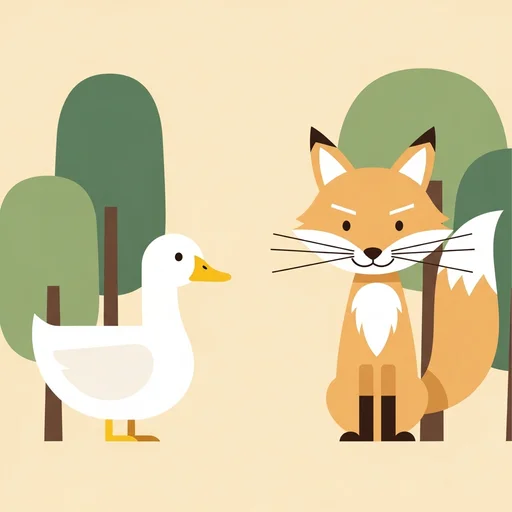
The Tale of Jemima Puddle-Duck
Jemima Puddle-Duck lived on a busy farm. She was a gentle duck who very much wanted to hatch her own eggs. But the farmer’s wife always took them away for the kitchen. “Quack, quack! I want to be a mother,” sighed Jemima.
One spring morning, Jemima made a plan. “I shall find a secret nest far from the farm,” she said, and she waddled through the gate and into the green wood.
Deep among the trees, Jemima met a very polite gentleman with sandy whiskers and a smart coat. His bushy tail was tucked neatly behind him. “Good day, madam,” he said with a bow. “You are looking for a nesting place? I have a quiet little shed that would suit you perfectly.”
Jemima was delighted. The gentleman led her to a neat shed filled with sticks and soft leaves. It seemed safe and still. “Thank you kindly,” said Jemima, and she began to lay her eggs, one by one, counting carefully. Soon there were nine eggs in a tidy nest.
The sandy-whiskered gentleman smiled. “What a fine nest! Perhaps we shall have a small dinner to celebrate. Would you be so good as to fetch a few things? Some sage and thyme, a sprig of parsley, and two onions. And please bring a little string for tying up—er—bundles.”
Jemima did not understand much about cooking, but she was eager to please. “Yes, sir,” she said, and off she waddled toward the farm to gather herbs from the garden.
At the farmyard gate stood Kep, the wise old collie dog. He sniffed the air and frowned. “Where have you been, Jemima?” he asked gently.
“I have made a lovely nest in the wood,” whispered Jemima. “A kind gentleman lent me his shed. I am fetching sage and thyme, and parsley, and two onions for his dinner.”
Kep’s ears pricked up. “Describe this gentleman,” he said.
“He has sandy whiskers,” said Jemima. “He is very polite.”
Kep’s eyes grew serious. “That is no gentleman,” he said. “That is a fox. Those herbs are not for an omelette—they are for roast duck. You must not go back there.”
Poor Jemima trembled. “Oh, my eggs!” she cried. “What shall we do?”
“Leave everything to me,” said Kep. He trotted off to the kennels and called two eager foxhound puppies. “Come along. There is work to be done.”
Kep led the puppies through the wood to the little shed. Inside, the sandy-whiskered gentleman was sharpening a knife and laying out plates. When he heard the patter of paws, he sprang up and darted toward the door.
The puppies burst in. There was a tumble and a scuffle, a scrabble of paws, and a flurry of feathers. The fox shot out like a streak of red and raced into the thicket, with the puppies baying close behind. He was chased far, far away and never came near the farm again.
Jemima hurried to the shed. “My eggs!” she quacked. In the commotion, every single egg had been broken. Jemima was safe, but her nest was gone. She cried a little, and Kep let her rest her head against his shoulder. “Better broken eggs than a broken duck,” he said kindly.
After that adventure, the farmer’s wife understood how much Jemima wished to be a mother. She gave Jemima a snug little coop in a quiet corner of the yard, safe from foxes and trouble. Kep kept watch with bright, careful eyes.
In time, Jemima laid new eggs and sat very steadily. At last, one happy morning, four soft ducklings peeped out from under her wings. “Quack, quack!” cried Jemima, proud and glad.
From then on, Jemima took her ducklings to the pond and taught them to paddle in the sunshine. And whenever she saw a stranger with sandy whiskers, she remembered Kep’s wise words and kept her little ones close by her side.
The end
