
H.C. Andersen
The Snowman
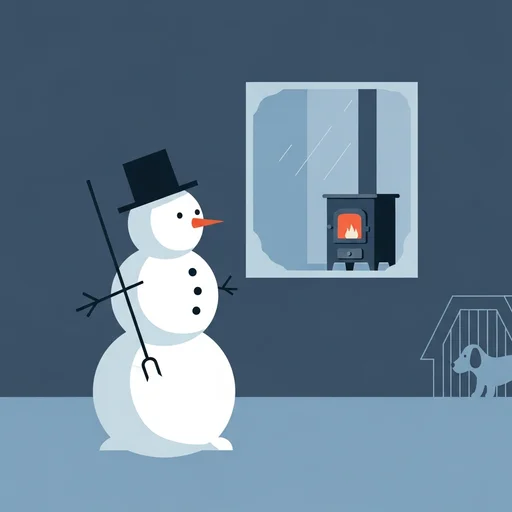
It was the kind of winter day that makes your breath puff like little clouds. The children in the big yard rolled three sparkling balls of snow—one, two, three—and stacked them, largest to smallest. They pressed in two black eyes, set a carrot for a nose, and patted him smooth and tall. When they were done, the Snowman stood proudly in the middle of the yard, white and bright against the blue evening.
As the moon rose and silvered the rooftops, the Snowman felt something like waking. He stared around at the quiet street, the frosty hedges, and the house with warm yellow windows. On the roof a weathercock turned, its metal rooster glittering.
“Cock-a-doodle-doo!” creaked the weathercock. “It will change! It always does!”
“What will change?” asked the Snowman, amazed to hear himself speak.
“The weather,” the weathercock clanked, pointing his beak one way and then another. “I am the one who knows. I turn and tell them. It will change!”
The Snowman tried to nod, and the frost in his neck joints crackled. “I am new,” he said. “Everything is new to me. I feel so—so fine and cold.”
“Cold suits you,” rattled the weathercock. “Just keep your head and don’t get ideas.”
From the shadow by the woodshed came a rattle of chain and a soft growl. An old yard-dog lifted his nose from his straw. His fur was shaggy, and his eyes were kind.
“Bow-wow,” said the Dog, which meant, “Good evening. You are a handsome fellow.” Then he added, “I used to know the world better than I do now. Once I lived in the house.”
“In the house?” The Snowman turned his whole stiff body to look at the windows, where firelight danced. “What is it like in there?”
“Warm,” said the Dog, with a sigh so deep his chain chinked. “There is a creature in there who eats logs and shines like red gold. She hums softly and never gets tired. We called her the Stove. When I was a puppy, I lay in front of her and toasted my paws. Oh, that was comfort!”
“The Stove,” whispered the Snowman. He peered through the lowest pane in the garden door. Yes—there she was: a black, polished shape standing so gracefully on her curved feet. In her middle was a little door with a round ring. Now and then someone fed her, and she glowed and breathed out a deep, gentle heat that made the window weep little drops. The Snowman thought she looked like a grand lady, bright and important.
“I must go closer,” he said.
“You must not,” warned the Dog. “She is lovely, but she is dangerous to your sort. If you love her too much, you will come to grief.”
“Love her?” The Snowman hardly knew the word, yet something in him tugged and ached. “When I look at her, I feel—” He creaked and could not find the rest.
“Keep cool,” clattered the weathercock from the roof. “It will change.”
That night the frost sharpened. The stars were tiny needles. The Snowman stood very still, watching the Stove shimmer behind the glass. People came and went, and the door of the stove opened and shut like a smile. “What a sweet face,” the Snowman murmured. “How she shines! She is made for me, I am sure.”
“Not for you,” said the Dog. “For kettles and soup and chilly fingers. I once lay right there.” He wagged, remembering. “I thought I would live there forever, but I snatched a bone from the cook, and out I came. Still, the Stove—ah! There is nothing like the Stove.”
Day after day the Snowman stood in the yard. The sun was pale and cold, and he liked that. At night the frost bit harder, and he liked that even more. His joints squeaked when he turned, but he turned, always turned, so that his eyes could rest on the Stove. Sometimes the moon would show on the glass like another bright eye. Sometimes the window grew white with ice ferns, and he could not see, and then he felt terribly lonely.
“Do not think so much,” advised the Dog. “Look at the sky, or listen to the mice under the snow. Let the Stove be.”
“I cannot help it,” said the Snowman. “Something inside me wants to go to her. It pulls and pulls.”
On the roof, the weathercock creaked around. “It will change!” he called. “It will change!”
It did. The days drew a little longer, the light a little stronger. Water dripped from the stable eaves, and the icicles grew thinner. The Snowman did not like this at all.
“It stings,” he said one afternoon, as a drop ran down his cheek.
“It is only a tear,” the Dog told him gently. “This happens when winter begins to slip away.”
“I do not want it to slip away,” said the Snowman. He stared at the Stove with all his might. “If I could only go inside, just once.”
But the gate was shut, and the door was shut, and the ground under him was growing soft. He felt himself settling. His fine roundness sagged. The carrot loosened. Where the snow had been tight, now it was heavy and wet.
“It will change,” croaked the weathercock, and he turned and turned.
One morning the children came out in rubber boots and splashed in puddles. The Snowman was smaller now, and leaning. “Stand up,” the smallest child cried, and patted him. He could not.
“I am not myself,” the Snowman whispered. He looked one last time toward the window. The Stove inside shone with a soft, steady glow. She seemed to breathe. “How beautiful you are,” he said, and as he said it, he gave a long, gentle sigh that sounded like a thawing icicle.
By evening he was gone. Where he had stood, the ground was wet and dark. In the middle of the damp circle lay a piece of black iron with teeth—an old stove-rake, the kind used to stir the fire.
The Dog padded over and sniffed. He wagged his tail, slow and wise. “Now it makes sense,” he said. “He had a stove-rake in him all the time. That is why he longed for the Stove.”
The weathercock rattled on the ridge. “It will change! It has changed!” he cried to the empty yard.
Summer came. The windows stood open, and the Stove rested, cool and quiet. The yard was green and busy with birds. The Dog dozed in his shade and dreamed of warm paws and crackling logs.
When winter returned, the children rolled three bright balls again and built a new snowman. He looked almost the same, but the Dog knew he was not the one who had stared at the Stove and sighed.
Still, when the moon rose and painted everything silver, the weathercock turned and told the sky, “It will change.” And the Dog, who remembered, laid his nose on his paws and kept the story in his heart.
The end
