
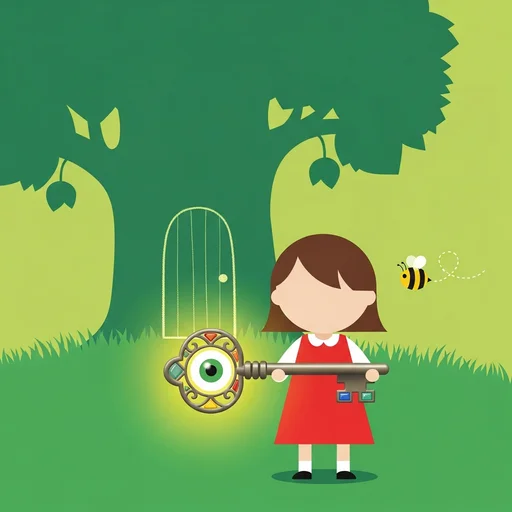
The Singing Key
It was a sunny mid-morning when Tilda found something that shone in the grass behind the red gate. It was a small key with a round eye and glass pieces that glimmered in all colors. When she picked it up, it tickled her hand and softly chimed – plink.
Tilda ran to Uncle Fenix, who had a shop called Things for Wizardry. The bells above the door sang when she stepped in. Uncle Fenix was a kind wizard with a soft hat and a coat full of small pockets. From one pocket he pulled out a magnifying glass, winked, and looked at the key.
– Oh, a singing key, he said and smiled. – It opens whatever sings back. But you must listen carefully. And when it's time, whisper: Key so small, sing with me, show the door, show the way.
Tilda thanked him and skipped home. She held the key against the teapot. It said clonk. She held it against her wooden horse. It said thunk. But when she stood under the old linden by the fence, the key began to hum warmly. Tilda put her ear against the bark. Behind it, she heard a faint melody, as if the tree hummed.
– Key so small, sing with me, whispered Tilda. – Show the door, show the way.
The key became brighter. On the trunk, a door drew itself as if someone had drawn with chalk. It clicked, and the door opened into a glade that glittered. The air smelled like summer rain and mint. The grass tickled her ankles, and small blue bubbles hopped by as if they were in a hurry somewhere.
– Hi! called a round bumblebee with a small checkered vest. – I'm Hilda! Welcome to Glimmer Glade.
– I'm Tilda, said Tilda and smiled. – My key sings.
Hilda nodded eagerly. – Lucky! The Wind Chime in the village has fallen silent. When it doesn't sing, all doors get stuck. Even our picnic basket is locked. Do you think your key can help?
Tilda patted the key. It answered with a little – plink. – We can try, she said.
They walked on a path that rustled like paper. A broom with a ribbon swept by and bowed. – Look by the Shell Well! said the broom and spun away.
By the well lay shells in rings. The water mirrored Tilda's nose. She held up the key and listened. First she only heard drip, drip. Then, far down there, a careful – plink.
– Hello there, said Tilda softly. – We hear you.
Inside a small glass jar with a cork sat something that blinked. It looked like a silver-drop of sound. It was a shy tone.
– I don't dare, peeped the tone. – My plink is too bright. Everyone will hear me.
Hilda hummed warmly. Tilda knelt and let the key sing low. – I like your plink, she said. – It's needed.
The key answered with – mmm-plink. Tilda whispered the rhyme again. The cork hopped off like a happy frog. The little tone spun out and sat on the key's eye, like a bird on a stick.
– To the Wind Chime! called Hilda and flew ahead.
The Wind Chime was a tower with long tubes of wood and shells. They hung still. Tilda stretched up the key toward the center and breathed deeply.
– Key so small, sing with me, she said. – Show the door, show the way.
The key sang. The little tone took off and hopped in among the tubes. First came a careful – plink. Then many more followed. The wind took hold. The Wind Chime awoke. It sang like a happy flock of birds. Locks clicked open around the whole glade. The lid on the picnic basket bounced up. Doors in the trees yawned and smiled.
– You did it! cheered Hilda and spun in the air. – Glimmer Glade can sing again!
The broom's ribbon fluttered. A small mushroom bowed. Tilda felt warm, like when the sun finds your shoulder.
Hilda tied a blue ribbon with a small bell around the key. – Because you dared to listen, she said.
Tilda and Hilda walked back to the linden. The door waited, soft and secret.
– Come back when you want, said Hilda. – We always have room for one more song.
Tilda stepped out into her garden again. Everything was the same: the cat stretched, a butterfly sat on a leaf. But in her pocket, the key sang a little – plink. Tilda smiled and put it in her treasure box. Sometimes, when the wind played with the leaves, she knew she heard a faint answer from the linden. Then she knew that a door waited, and that the song would find her when needed.
The end
