
H.C. Andersen
The Shadow
Once there lived a learned man who loved to write about what is true, good, and beautiful. He went south to a very hot country, where the sun blazed from morning to night. In such heat, people stayed indoors by day and came out only when evening cooled the streets.
The learned man sat on his little balcony and looked across at a house with a broad terrace. Flowers climbed its rails, and at night a gentle light glowed behind a curtain. “Who lives there?” he wondered. “It must be Poetry itself—the beauty that whispers to the heart.” He longed to know, but the glare of the sun had flattened his own shadow until it grew thin and tiny beneath his chair.
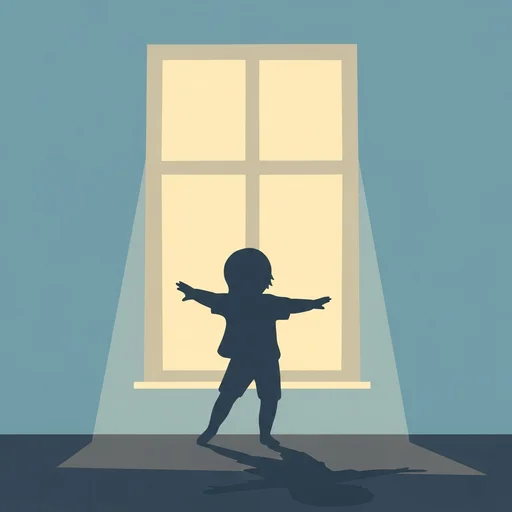
“Go and look,” he whispered, teasing his shadow. “Slip across and find the secret of that light.” The shadow understood, or so it seemed. When the lamp in the opposite house burned brightest, the learned man leaned forward and called softly. The shadow trembled, stretched, and—like a ribbon—slid off the wall, across the street, and under the curtain of the glowing window. The learned man waited and waited. He whistled. He called. But the shadow did not return.
In time, as shadows will, a new one grew from his heels. It was small at first, and shy, but by and by it learned to follow him properly. The learned man went back to his colder home and wrote again about the true, the good, and the beautiful. He sometimes thought of the hot country and the house with the gentle light, and he sometimes thought of his lost shadow, but life went on.
One winter evening there came a knock at his door. A stranger stood there—so elegant, so thin, with a face pale as paper and clothes as fine as silk. “May I come in?” he asked. “I have grown a body at last.”
“Who are you?” said the learned man.
“Don’t you know me?” said the stranger, smiling. “I am your old shadow.” He bowed so low that his hat nearly touched the floor. “I have seen much since I slipped away. Shadows go where people cannot. I slid behind chairs and through keyholes. I learned how people truly are when the light is behind them.” The more he spoke, the colder the room felt.
The learned man shivered. “I prefer what is true and bright,” he said. “It is not good to peep into what is hidden and mean.”
“True,” said the shadow, “but the world is not only bright rooms and open windows. I know things, and I am rich now. Let us travel together. It will amuse you, and I will pay for everything.”
They made a plan. They would go to a grand city by the sea, where many fine people gathered. “One favor,” said the shadow. “In public, you must call me Master, and I will call you my shadow. It is only for appearances. People love appearances.” The learned man frowned. “Only as a joke,” he said at last. “Never as the truth.”
So they traveled together. The elegant shadow-man knew exactly how to bow to ladies and how to flatter gentlemen. He never stood in the light by mistake. He knew when a smile was false and when a promise was thin as paper. The learned man grew quiet. He grew pale. He spent more time in his room, for the world felt louder and colder than before.
Soon everyone in the city spoke of the clever stranger who saw through people as easily as through glass. The princess herself heard of him. She was clever too, and she wished to marry a man who could see truly, for a ruler needs clear eyes. She sent for the elegant stranger.
The shadow was perfect. He answered everything well and wore his wisdom like a cloak. “How do you know so much?” asked the princess.
“I have traveled where others dare not,” said the shadow with a careful smile. “I have seen people’s dark sides and their bright ones.”
The princess was impressed. “You may be the one,” she said. “But who is that pale person who follows you?” She pointed to the learned man, who stood behind, as he had promised, like a shadow.
“That?” said the shadow lightly. “Only my shadow. He is not quite well, and shadows are not very clever.”
The learned man’s heart pounded. “Your Highness,” he said, “forgive me. I must speak. The truth is turned around. He is my shadow, or he was, long ago.” He told the whole story—about the hot country, the gentle light, and the shadow that slipped away.
The princess laughed a little, not unkindly, but she liked order and disliked confusion. The elegant stranger put a finger to his lips. “He is feverish,” he said softly. “He believes what shadows sometimes believe.” He spoke so calmly that even the guards nodded. Soon the learned man found himself alone in a quiet room with a locked door.
Later, the shadow visited him. His voice was smooth as silk. “We were friends,” he said. “You taught me to stand in the light. Now I am more than a shadow. Become my shadow truly, and I will set you free. You shall have clothes and a place, and no one will trouble you.”
“I will never be a lie,” said the learned man. “I will never pretend that night is day.”
“Then you will not suit this bright court,” the shadow replied. “Here, appearances are everything.” He sighed as if he were sad, and slipped away.
The wedding day came. Bells rang. The city cheered for the clever princess and the cleverer bridegroom. That morning, the learned man was led out through a side gate and quietly put to death, for the shadow had ordered it. Few noticed; no announcement was made. By noon the music swelled, and by evening, lights twinkled in every window.
The princess married the shadow, and people said the kingdom had never seen such a brilliant pair. They seemed to understand everything. But the truth, the good, and the beautiful were quieter after that, as if they had stepped back a little from the bright rooms and the open windows. And no one spoke of the man who would not pretend, though his story is still told to those who listen.
The end
