
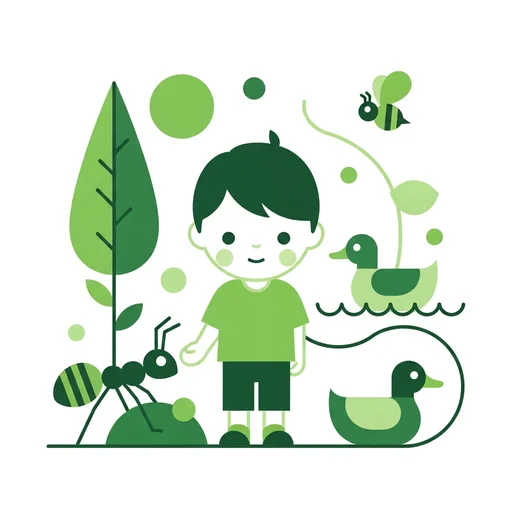
The Queen Bee
Once upon a time there were three brothers who set out to see the world. The two eldest were clever and proud. The youngest was gentle and cheerful, and because he did things in his own thoughtful way, people called him Simpleton. His brothers laughed at him, but he did not mind. He simply kept walking with a light heart.
On their path the brothers came to a forest, where a busy anthill rose like a tiny city. The eldest brother picked up a stick. “Let’s stir it up and see them run!” he said. The second brother grinned. But the youngest stepped in front of them and spread his arms. “Leave the little creatures in peace,” he said. “They have done us no harm.” The elder brothers rolled their eyes and went on, while the ants swarmed safely over their mound, shining in the sun like drops of black pepper.
Soon the brothers reached a blue lake freckled with reeds. Ducks drifted across the water, quacking softly. “We’ll catch a few and roast them tonight,” said the second brother, reaching for a branch to throw. “No,” the youngest said quickly. “Leave the creatures in peace. They look at us without fear. Let them keep their lives.” The elder brothers muttered, but they put down the branch, and the ducks paddled on, leaving silver ripples behind.
Farther along, the road passed beneath an old oak tree, broad as a ship. High in its hollow was a beehive, golden honey dripping down the bark. “If we smoke them out, we can take the honey,” said the eldest, already gathering dry leaves. “No,” said the youngest again. “Leave the creatures in peace. The bees work hard for their sweetness.” The elder brothers sighed and went on, empty-handed. Overhead the bees hummed like a soft bell.
At last the three came to a strange castle, quiet as winter. The gate stood open. In the stables, the horses stood like statues, not breathing, not blinking. In the great hall, servants sat at tables as still as painted figures. Yet on a sideboard, a meal steamed as if it had just been set out. Hungry and puzzled, the brothers ate and then lay down on three beds prepared nearby. The castle was so silent that their own breathing sounded loud in their ears.
When morning came, they found a tall table with a great sheet of parchment upon it. In neat letters it read: “Whoever wishes to break the spell upon this castle must perform three tasks. If he fails, he shall be turned to stone.” The first task was written beneath: “In the forest lie a thousand pearls belonging to the king’s daughter. Before the sun sets, every single pearl must be gathered.” The eldest brother laughed. “A child’s game,” he said, and went to the forest. He picked up pearls until his back ached, but a thousand proved a daunting number. Evening fell, and he had not found them all. In an instant he hardened into gray stone. The second brother tried the next day and fared no better. By sunset he too stood cold and silent in the glade.
Now it was the youngest brother’s turn. He walked into the forest and looked at the wide carpet of leaves. Pearls hid like dewdrops. “How can one person gather a thousand?” he whispered. He sat on a stump and felt a tiny tickle on his boot. The ants from the anthill had arrived, line upon line, as neat as soldiers. They fanned across the forest floor, and with their small bright jaws they found the pearls and piled them into shining heaps. By the time the sun touched the treetops, every last pearl lay in a neat circle at the youngest brother’s feet. He carried them to the castle, and the first task was done.
The second task was written below the first: “The key to the princess’s chamber lies at the bottom of the lake. Fetch it.” The eldest and second brothers could not try, for they stood as stone in the wood, so the youngest went alone to the water’s edge. He stared at the deep green lake and sighed. “I cannot swim to the bottom,” he said. Just then the ducks he had spared glided toward him, their eyes bright. One duck dived with a flick of its tail, and then another, and another. In no time they rose again, and in the yellow beak of the last duck glinted a little iron key. The youngest thanked them warmly, took the key, and hurried back to the castle.
The third task said: “Among the king’s three sleeping daughters, choose the youngest. If you choose wrongly, you shall be turned to stone.” The brothers who might have helped with guesses were not there, and the three princesses lay side by side upon silken beds, their faces so alike that even a mother might hesitate. The youngest brother stood, heart thumping. He looked for a sign but saw none.
Then there came a soft, silvery humming. Through the open window flew the queen bee, grand and bright, followed by a drifting cloud of her sisters. Around the room they circled once, twice, and then the queen bee settled gently upon the lips of one princess. “This one tasted honey before she slept,” the youngest brother murmured. “And who knows honey better than a queen bee?” Trusting his friends, he pointed to that princess.
At once the charm broke. The three sisters stirred and opened their eyes. The servants in the hall stretched and yawned. The horses in the stable stamped and shook their manes. Statues in the forest softened into flesh and breath, and among them were the eldest and second brothers, blinking in surprise. The castle rang with laughter and clapping, and the king himself, who had slept for many years, embraced his daughters and the young man who had freed them.
Because he had completed the three tasks, the youngest brother was given the youngest princess’s hand. His elder brothers, forgiven and glad to be alive, married the other two sisters. The king shared his realm, and the bees hummed in the garden, the ducks dabbled on the lake, and the ants marched busily along the paths. Everyone agreed that kindness to small creatures had brought great good, and the youngest brother, no longer called Simpleton, ruled with a gentle heart. And that is how the queen bee herself helped choose a queen.
The end
