
Asbjørnsen and Moe
The Princess on the Glass Hill
Once upon a time, there was a farmer with three sons. The two oldest were strong and proud. The youngest was called Boots, because he liked to sit by the warm stove and scrub his boots, and everyone thought he didn’t amount to much. But Boots watched and listened more than he spoke.
Every Midsummer Eve, something strange happened. The farmer’s finest meadow—thick with sweet hay—was flattened in a single night, as if a giant had rolled on it. The farmer wrung his hands. “How shall we feed the cows if our meadow is ruined?” he cried. At last he said, “One of you must keep watch when Midsummer comes again.”
The oldest son went first. He sharpened his scythe, tucked a knife in his belt, and said he would show the thief a thing or two. He sat in the meadow until midnight. Then the ground began to tremble. It shook once, twice, three times, so hard the grass rippled like the sea and stones jumped. The oldest son felt his teeth rattle. He leaped over the fence and ran home as fast as his legs would go. In the morning the meadow was crushed as flat as a pancake.
Next Midsummer, the second son said, “I’m braver than he is. I’ll fix it.” He sat in the meadow until midnight. The earth quaked once, twice, three times, even louder than before. The second son felt his heart thumping in his throat. He scrambled away, and in the morning the meadow was ruined again.
When the third Midsummer came, Boots said softly, “Let me try.” His brothers jeered, but the farmer sighed and nodded. Boots took a piece of oatcake and a chunk of cheese and went to the meadow alone. He sat very still and watched the stars climb the sky.
At midnight the earth shook once, twice, three times, like thunder rolling under his feet. The grass bent and a crack opened in the hillside. Out sprang a great horse with a copper saddle and bridle, and beside it lay a suit of copper armor, just the right size for a rider. The horse stamped and snorted. Boots didn’t run. Quick as a blink, he caught the copper bridle and spoke kindly. “Easy, now. No harm.” The horse tossed its mane, then stood quiet. It let Boots take the saddle and armor too. When the tremors stopped, Boots led the horse away and hid it and the copper gear under hay in an empty shed, where no one would think to look. In the morning the meadow stood tall and safe.
The next night, Boots kept watch again. The ground shook even harder—once, twice, three times—and a silver horse burst out, with a silver saddle and bridle, and a shining suit of silver armor. Boots was ready. He caught the bridle, soothed the horse with a pat, and hid it with the silver gear beside the first.
On the third night, the trembling roared like a storm. A golden horse leaped from the hill, with a golden saddle and bridle and a suit of golden armor bright as the sun. Boots caught and calmed this one too, and hid it away. After that, the meadow was never troubled again.
Not long after, news flew through the land. The king had built a hill of glass in the great field before his castle. It was as smooth as ice and as steep as a church tower. At the very top sat the king’s daughter, holding three golden apples. “Whoever can ride up and take these apples shall have the princess for his bride,” proclaimed the king. The trial would be held over three Sundays.
On the first Sunday, the farmer and his two oldest sons dressed in their best and went to watch. Boots asked to go too. “In those shabby clothes?” the brothers laughed. “Stay home by the stove.” But Boots went anyway, keeping to the back of the crowd. Lords and knights spurred their horses and tried the glass hill. Up they rushed—down they slid. Hooves clattered, men tumbled, and not one climbed more than a few steps.
When the day was almost done and the sun leaned low, Boots slipped away to the wood. There he put on the copper armor, mounted the copper horse, and galloped into the field so fast that the wind whistled. All turned to stare. Up the glass hill the copper horse went—one-third of the way, no more—but that was farther than any rider yet. The princess leaned down and tossed a golden apple. Boots caught it in his glove. Before anyone could grab his bridle or ask his name, he wheeled the copper horse and vanished into the trees.
On the second Sunday there was an even greater crowd. The knights tried, slipped, and slid, and the people shouted and groaned. Near sunset Boots dressed in shining silver and rode the silver horse into the field. Up he went—higher than before, two-thirds of the way. The princess smiled and tossed the second apple. Boots caught it and, like a flash, turned and was gone.
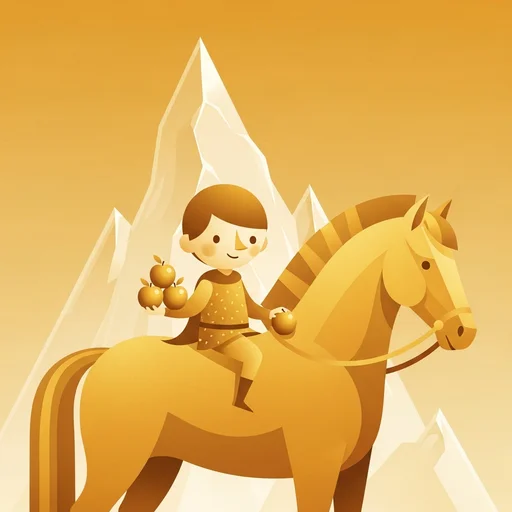
On the third Sunday the field was so full that it seemed no more folk could fit. “Now we’ll see who takes the last apple,” everyone said. The brothers boasted loudly that they had come close before and would surely win today. At the last moment, a rider in gold armor on a golden horse burst from the wood. He rode straight at the hill and climbed to the very top. The golden horse did not slip at all. Boots bowed to the princess. She dropped the third apple into his hand, and he saluted her before riding down and away.
The king stood before the crowd and called, “Bring forth the man who has the three apples, for he shall wed my daughter.” Many fine gentlemen claimed they had caught one, but when asked to show it, none could. The farmer’s two oldest sons bragged that perhaps the apples were at home, safe in a chest, but they had nothing to prove it.
Then Boots came forward in his everyday clothes. People laughed at first, but Boots reached into his pouch and laid all three golden apples before the king. The king’s eyes widened, and the princess’s face lit with joy. “So you are the rider,” she said. Boots nodded.
The king kept his promise. Boots married the princess that very day. The bells rang, and the people cheered. The farmer blinked, then smiled until his cheeks ached. As for the two older brothers, they learned to hold their tongues.
Boots was no longer the quiet boy by the stove. He was the rider of the copper, silver, and golden horses, the lad who did not run when the earth shook. He and the princess lived happily, and Boots helped the king. And if you ever see a glint on a hillside at Midsummer, it might just be the shine of a bridle, waiting for someone brave and kind enough to take hold.
The end
