
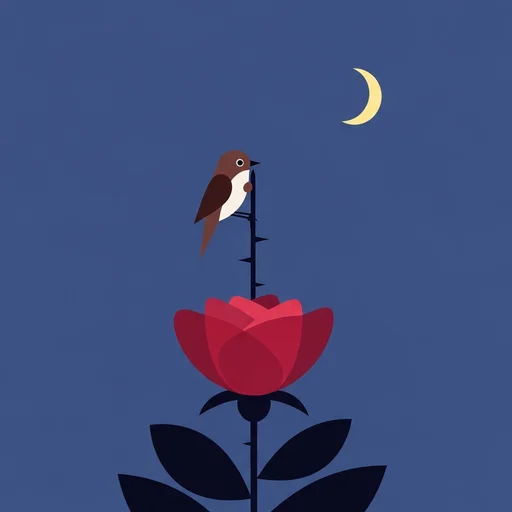
The Nightingale and the Rose
In a quiet town, a young Student sat in his garden and covered his face with his hands. “She said she would dance with me if I brought her a red rose,” he whispered, “but there is no red rose in my whole garden.”
High in an oak tree, a small Nightingale heard his words. She loved to sing of brave hearts and true love, and her eyes sparkled. “Here at last is a true lover,” she said. “He is sad because he needs a red rose. I will help him.”
The Nightingale hopped down and flew to the nearest rose-tree. “Give me a red rose,” she asked, “and I will sing you my sweetest song.”
“My roses are white,” said the first tree, “white as sea foam. I cannot help you.”
So the Nightingale flew to a second rose-tree. “Give me a red rose,” she begged, “and I will sing until your leaves tremble with joy.”
“My roses are yellow,” said the second tree, “yellow as the hair of a mermaid. I cannot help you.”
At last the Nightingale flew to the rose-tree that grew by the sun-dial in the center of the garden. “Give me a red rose,” she said, “and I will sing all night long.”
“My roses are red,” said the rose-tree, “red as the feet of the dove and redder than the great coral that waves in the sea. But winter has chilled my veins, and the frost has bitten my buds. I shall have no roses this year.”
“Is there any way?” asked the Nightingale, her small heart beating fast.
“There is a way,” said the rose-tree, “but it is a terrible way. You must build me a rose out of music by moonlight and stain it with your own heart’s blood. You must sing with your breast against a sharp thorn all night long. The thorn must pierce your heart, and your life will flow into my branches. Only then will I bear a single red rose.”
The Nightingale grew very quiet. She thought of the Student’s tearful eyes. She thought of all the songs she had sung about love. “Life is precious,” she whispered, “but love is greater than life. What is the heart for if not to give?”
She flew back to the Student and perched close to him. He was still weeping. “Be happy,” she sang softly, though he did not understand the language of birds. “You shall have your red rose.”
When the moon rose and the garden grew silver and still, the Nightingale flew to the rose-tree by the sun-dial and pressed her breast against the cruel thorn. It pricked her, and a bright pain shot through her. Then she began to sing.
She sang of spring, when the first leaves open like tiny green hands. She sang of lovers walking under the stars and of promises spoken in whispers. At first the rose on the branch was pale, white as the mist.
“Press closer,” said the rose-tree, “or the rose will not take the color.”
Closer the Nightingale pressed, and her song grew stronger. She sang of warm summer nights and of a boat on a quiet lake, where two people watch the moon ripple on the water. The white petals turned faintly pink.
“Closer,” said the rose-tree, “or it will be only the color of dawn.”
The Nightingale pressed closer still, and the thorn went deeper. Her voice grew pure and clear, finer than silver, braver than a drum. She sang of a heart that gives and does not count the cost. She sang of love that is faithful even when no one sees. As she sang, the rose flushed deep red, petal by petal, like a fire kindled at its heart.
Once more she lifted her little head to the stars, and her last song was the strongest of all. She sang of love that is stronger than fear, and of a promise kept to the end. The rose burned crimson, rich and perfect. Then the Nightingale fell still, and the garden was quiet.
At dawn the Student opened his window. He gave a cry of joy, for there on the rose-tree by the sun-dial grew the most beautiful red rose he had ever seen. Its petals were like rubies, and its smell was sweet as honey. He cut it carefully and ran to the Professor’s house.
“You asked for a red rose,” he said to the Professor’s daughter, holding it out with shining eyes. “Here it is! Will you dance with me tonight?”
But the girl pouted and shook her head. “I am afraid it will not go with my dress,” she said. “And besides, the Chamberlain’s nephew sent me jewels. Everybody knows that jewels are more valuable than flowers.”
“More valuable!” cried the Student, and his face grew pale. “You are ungrateful and shallow.”
“Ungrateful?” the girl answered. “And you are rude. I prefer the Chamberlain’s nephew. He wears fine shoes and his hair is neatly combed.” She turned away and went into the house.
The Student stood very still. Then he threw the red rose into the street. It fell into the gutter, and a cart-wheel splashed through the mud and crushed it.
He walked back to his room. He took down a heavy book and opened it. “What foolish things people say about love,” he muttered. “It is not useful. It is not true. Logic is better. It has proof.”
Outside, the sun warmed the quiet garden. The oak leaves whispered, and the rose-tree by the sun-dial held its empty stem toward the light. Somewhere in the shadows lay a small brown feather. No one saw it, and no one heard the song that had filled the night.
But the rose had been red, and the Nightingale had kept her promise.
The end
