
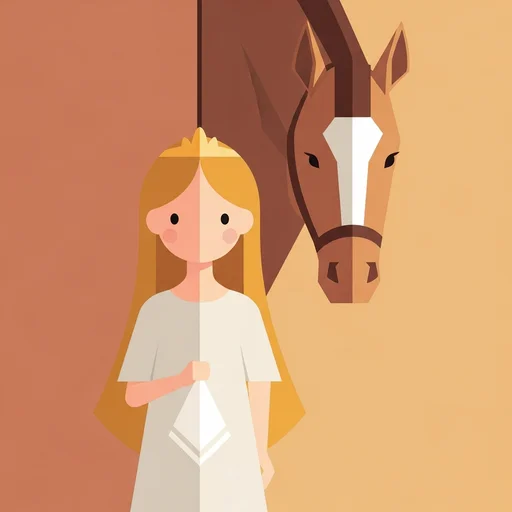
The Goose Girl
Once upon a time, a queen sent her daughter to marry a prince in a faraway land. To keep her safe, the queen pricked her finger and dropped three bright drops of her own blood onto a white handkerchief. “Guard this carefully,” she said. “As long as you have it, my love will protect you.” The princess set out with a faithful maid and her talking horse, Falada.
At first the road was smooth, but soon the maid grew proud and unkind. When they came to a stream, the maid refused to hold the princess’s horse or fetch water. The gentle princess climbed down, cupped water in a golden cup, and drank. From the handkerchief she tucked in her bodice, the three drops of blood whispered softly, “If your mother knew, her heart would break in two.” The princess carried on without complaint.
At the next stream it happened again. The maid sat tall and would not help. The princess climbed down once more. As she leaned over the water, the handkerchief slipped from her fingers, fluttered, and floated away. She reached for it, but the current carried it out of sight. From that moment the princess felt very small and very alone, as if her mother’s strength had left her.
Seeing this, the maid took charge. She ordered the princess to trade clothes with her and to swear never to tell a soul what had happened. The maid mounted the proud Falada and made the true princess ride an old, bony nag. So they arrived at the prince’s castle: the maid pretended to be the royal bride, and the true princess, wrapped in plain rags, was told to help in the yard. Because she was quiet and kind, the old king noticed her, but he said nothing yet. The false bride, afraid the horse might speak, ordered Falada killed. When the true princess heard, her heart ached, but she begged the knacker, “Please, please, nail Falada’s head beneath the dark gate where I pass each morning, that I may still greet him.” The man took pity and did as she asked.
Next morning, the poor goose girl—for she had been sent to tend geese with a boy named Conrad—walked through the gate and looked up. “Alas, Falada, hanging there!” she whispered. And the horse’s head replied, clear as bells, “Alas, young Queen, passing by! If your mother knew, her heart would break in two.” Then she and Conrad drove the geese into the meadow.
In the wide field, Conrad watched the goose girl shake out her long, bright hair. It shone like gold in the sun. He tried to pull a strand, just for fun. But the girl sat on the grass and sang, “Blow, blow, gentle wind, I pray—blow Conrad’s little cap away! Let him chase it, far and near, while I braid my golden hair.” At once a playful gust whisked off his cap, and Conrad ran after it while the princess quietly braided her hair. At noon it happened again, and again the wind danced off with his cap. That evening Conrad marched to the old king and grumbled, “The goose girl won’t let me touch her hair. She sings to the wind, and my cap goes flying!”
The king grew curious. At dawn he stood hidden behind the dark gate and heard the girl murmur, “Alas, Falada, hanging there!” and the head answer, “Alas, young Queen, passing by! If your mother knew, her heart would break in two.” He followed at a distance to the meadow and heard the rhyme to the wind. He saw the cap tumble and the girl’s hair shine. He went home deep in thought.
That evening the king called the goose girl to him and asked gently, “Why do you speak to the horse’s head? Why does the wind obey your song?” She lowered her eyes. “Your Majesty, I have sworn not to tell any person on earth. If I do, I will lose my life.” The king nodded. “Then tell your sorrow to the old iron stove in the cellar. A stove is no person.” He led her to the great black stove and left her there.
Thinking she was alone, the girl pressed her hands to the cold iron and poured out her whole story: the journey, the lost handkerchief, the maid’s threats, the change of clothes, Falada’s death, and her days among the geese. But the king had placed a little pipe behind the stove and listened, and now he knew the truth.
He brought her up and dressed her in silk and jewels, as befitted a princess. He sent for his son, the prince, and told him everything. The prince’s face burned with anger for the false bride and with pity and joy for the true one. The king ordered a great feast and invited the whole court. The false bride sat grandly at the high table, not knowing what was to come.
When all were eating, the king asked the false bride in a clear voice, “What should be done to a servant who betrays her mistress and steals her place?” Thinking she was safe, the false bride answered, “She should be put into a barrel studded with sharp nails and dragged by horses through the streets.” The king stood and said, “You have judged yourself.” And so she was punished in the very way she had named.
The true princess took her rightful place beside the prince. The old king smiled to see honesty shine brighter than gold. Conrad minded his geese more politely from then on, and the wind kept its mischief for the trees. Though Falada could not return, the memory of his faithful voice stayed with the princess all her days. The wedding lasted three days, and from that time forward the prince and the Goose Girl lived together in truth and gladness, and no one could mistake them ever again.
The end
