
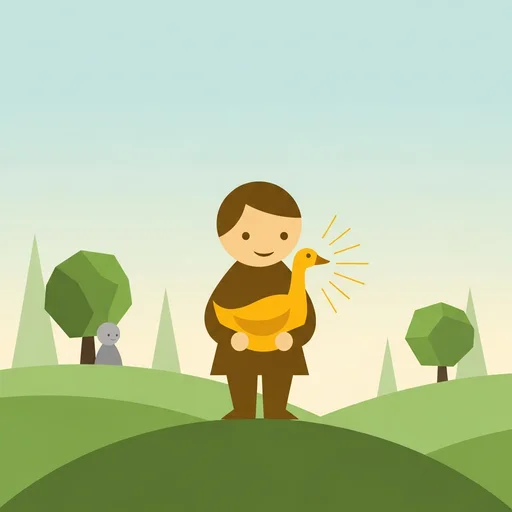
The Golden Goose
Once there was a man with three sons. The two older brothers were clever and proud. The youngest was gentle and often called Simpleton, though his heart was kind. One day their father said, "Go to the forest and fell trees. We need the money." The eldest went first. Their mother packed him a fine cake and a jug of sweet wine.
In the forest, a little gray man stepped from behind a tree. "Please," he said, "may I have a bite of your cake and a sip of your wine? I’m very hungry." The eldest brother frowned. "What I have is for me," he snapped, and turned away. He swung his axe at a tree, but the blade glanced off and struck his arm. He had to limp home in pain.
The second brother went next. He too took a good cake and a jug of wine. The little gray man asked him for a share. "Not a crumb!" the second brother said, and pushed past. When he raised his axe, it slipped and cut his leg. He also had to hobble home.
At last the youngest said, "I’ll go." His mother sighed. "You? Very well. I have only a little burnt loaf and some sour beer left." Simpleton thanked her, tucked the small meal into his bag, and set off.
In the forest, the little gray man appeared again. "Friend," he said softly, "may I taste your food and drink?" Simpleton smiled. "Of course. We can share." He broke the loaf, and though it was small, it seemed enough for two. He passed the beer, and somehow it quenched them both.
The gray man’s eyes twinkled. "Because you shared your poor meal without fuss, you shall be lucky. Cut down that old tree over there, and you will find something special." Then he vanished among the leaves.
Simpleton swung his axe, and the old tree cracked and fell. In its roots he discovered a goose with feathers that shone like the sun—every plume bright gold. "What a wondrous goose!" he whispered. He lifted it carefully and carried it to a nearby inn for the night.
The innkeeper had three daughters. When they saw the golden goose, their eyes grew wide. The eldest thought, If I pluck just one feather, I’ll be rich! She waited until Simpleton was fast asleep, then reached out. But the moment she touched the goose, her fingers stuck. She could not pull away.
Soon the second sister tiptoed in. "What are you doing?" she whispered. "Help me!" hissed the first. The second grabbed her arm—and stuck fast too. The third sister came and tugged at the second—and stuck as well. All three were trapped in a line.
At dawn, Simpleton woke up, slung the golden goose under his arm, and set out for the road, not noticing the girls trotting behind him, stuck hand to dress, dress to hand. People stared and laughed as he passed. In a field he met a parson. "Shame on you, girls! What a sight! Let go at once!" He reached to pull the last one away—and stuck to her. The sexton ran up to help the parson—and stuck to him. Two farmhands tried to free the sexton—stuck! Soon there was the strangest parade: Simpleton in front with the golden goose, and a long, wobbling string of people tugging behind, each unable to let go.
They came to a city where the king had a daughter who never smiled. The king had promised, "Whoever makes my daughter laugh shall have her for a bride." The princess stood by a window as Simpleton marched past with his golden goose and the jerking, scrambling line of people. The sight was so ridiculous that she burst into laughter—great, ringing laughter that had never been heard from her before.
Simpleton was led to the palace. The king frowned. He did not like that a poor woodcutter’s son had succeeded. "Very well," he said slowly, "you made my daughter laugh. But before you can marry her, you must do three things for me. First: bring me a man who can drink the whole cellar of wine beneath this castle." He smiled, thinking it impossible.
Simpleton remembered the little gray man and went back to the forest. The gray man was waiting. "You shared fairly; I will help fairly," he said, and sent Simpleton along a path. There Simpleton met a man whose face was dry and cracked with thirst. "I can drink a river," the man said. "Come with me," Simpleton answered. At the castle, the king led them to the cellar. The thirsty man put the first jug to his lips and never stopped until he had drained every barrel and cask to the last drop. "Done," he said, smacking his lips.
The king pressed his lips together. "Second task," he said. "Bring me a man who can eat a mountain of bread." He ordered bakers to fire up all the ovens in the city, to bake and bake until bread lay piled like a hill.
Simpleton returned to the forest. The gray man pointed to a stump where a fellow sat tightening a belt around his waist. "I am always hungry," the fellow groaned. "Then you’re just the one I need," Simpleton said. They came to the castle. The hungry man loosened his belt and ate. He ate rolls and loaves, crusts and crumbs, until the whole mountain had vanished and not a crumb remained. "Done," he said, patting his belly.
The king’s face turned red. "Third task," he said sharply. "Bring me a ship that can sail on land as well as on water. If you arrive in such a ship, you shall have my daughter. If not, you shall not." He believed this would end the matter.
Simpleton went once more to the forest. The gray man stood at the edge of a shimmering pond. "You have a kind heart," he said. "Here is your reward." He pointed, and out of the mist came a curious ship—light as a leaf and strong as oak. When Simpleton stepped aboard, it glided forward, not only over water but smoothly over fields and roads, sailing as if the earth were sea.
He steered the ship straight to the palace gates. The king could not refuse any longer. A wedding was held, and the princess beamed with joy. The guests laughed to remember the golden goose and the silly parade. As for Simpleton’s brothers, who had mocked him, things went poorly for them afterward. But Simpleton and his bride were kind in fortune as in poverty, and they ruled with gentle hearts.
And the little gray man? They say he smiled in the forest and went on his way, pleased that a small kindness had set so many good things in motion.
The end
