
H.C. Andersen
The Elder-Tree Mother
It was a wet day, and a little boy had splashed through puddles until his socks were soaked. By evening his head ached and his throat felt scratchy. His mother tucked him into bed by the warm stove and said, "We will make elderflower tea. It chases away chills."
A friend came to visit, a cheerful student who knew many stories. He took off his damp hat and shook out the rain. "Elderflower tea?" he said. "Then perhaps the Elder-Tree Mother will pay us a visit. When the steam rises, she often does."
The boy blinked. "Who is the Elder-Tree Mother?"
"You shall see," the student replied. The mother smiled and set a brown teapot on the table. Outside, in the small courtyard, an old elder shrub stood with bare dark branches. Inside, the kettle sang. Soon the mother poured hot water over the dried white blossoms, and a sweet, green smell filled the room.
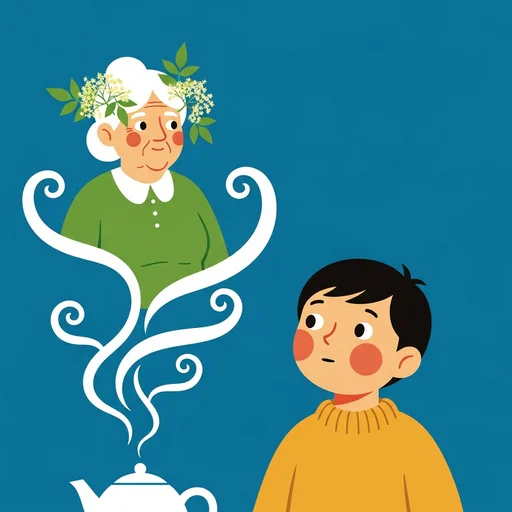
At that very moment, the steam curled and twirled, and the boy thought he saw a little lady step out of the mist. She wore a dress the color of fresh leaves. On her head was a crown of white elderflowers. Around her neck hung a string of tiny berries, dark as shiny beads. She curtsied so neatly that the boy forgot to be surprised.
"Good evening," said the little lady. Her voice was soft, like leaves rubbing together. "I am the Elder-Tree Mother. In spring I am young and wear blossom crowns. In autumn and winter I am older and wear berries and black silk. I come wherever my elder grows, and wherever good tea is poured. Shall we tell a story?"
The boy felt warm already. "Please," he whispered.
The Elder-Tree Mother held out her hand. The teapot suddenly seemed wide as a lake. The steam shone like silver. Together they peeped, as if the shining steam were a window. "Look," she said. "This is your own courtyard, not many years ago."
There stood the elder shrub, fresh and green. Under it sat a little boy and a little girl on a wooden bench. They shared a piece of bread and laughed. Their hands were messy with jam, and they wiped them on the leaves when they thought no one was looking. The boy in bed smiled; even sick, he could not help it.
The steam swirled again. Now the children were bigger. They had made a ship from an old washtub and were sailing it across a puddle. The little girl wore a wreath of elderflowers in her hair. The boy had stuck a leaf in his cap. They told each other that one day they would see the world, but only if they could be home by supper.
The steam rose and cleared, and time leaped forward. The elder had grown thicker. Guests came through the little gate. There were smiles and songs. The young man and young woman—were they the same children?—stood under the elder branches while white petals fluttered down like spring snow. A garland hung over the doorway. Someone played a tune, and the elder leaves trembled as if they clapped.
"A wedding," the boy whispered.
"Yes," said the Elder-Tree Mother. "People change and grow, but the elder remembers."
Again the pictures shifted. A cradle now stood in the shade, and a baby slept inside it. The mother rocked with her foot and hummed, and the father carved a small wooden horse. Summer passed to autumn. The elder berries shone like black pearls, and the mother gathered them for syrup and jam. Winter came. The Elder-Tree Mother, older now in a black silk gown, shook out a quilt of snow that covered all the roofs and made the courtyard bright and quiet.
Spring returned, and the elder foamed with blossoms. The baby became a child and chased shadows across the paving stones. At times the father went away with a pack over his shoulder, or a bundle of goods, or perhaps to sea—no one could tell exactly from the steam—but he always came home to the bench under the elder. Stories and letters traveled there too. The tree listened to everything and nodded with every wind.
Years hurried by in the space of a breath. The child who had slept in the cradle now carried books to school. The mother’s hair had a strand of silver, and the father had a few lines around his eyes. Still they sat under the elder to rest, to talk, to make plans, and to forgive each other when plans went wrong. In summer they tied up a swing on the strong branch. In autumn they dried berries for syrup against winter colds. In winter they spread crumbs for birds who left tiny footprints on the snow.
Then the steam danced one more time, and the boy saw the couple again. Their faces were soft with years. Their hair was white, white as elder blossom. They sat close together on the bench, and their hands, old and brave, held fast. The courtyard was the same. The elder was still there, and so was the little gate, and the warm kitchen with the brown teapot. The old pair smiled, and in their eyes you could see every season they had lived.
"Is it the same people all the time?" the boy asked.
"It is," the Elder-Tree Mother said. "Life grows and changes like my tree. Bud, blossom, berry. Spring, summer, winter. But kindness, patience, and home can stay."
The boy’s eyelids felt heavy. The elder smell was sweet and soothing. "I like this story," he murmured.
"Then drink your tea," said the Elder-Tree Mother, "and keep it with you." She curtsied again, and the steam thinned into ordinary kitchen air.
The mother lifted the cup. "Here is your tea," she said. "Sip it while it’s warm." The boy drank. The student winked at him over the rim of his own cup, as if to say, "We both saw her, didn’t we?" The boy wasn’t quite sure whether he nodded in answer or fell asleep first.
All night he dreamed he sailed in a little ship across a silver sea, with elderflowers falling like gentle snow. In the morning the rain had stopped. The sun cast a bright square on the floor. The boy’s head no longer ached, and his throat felt better.
He sat up quickly. "Mother, I think the Elder-Tree Mother came."
His mother smoothed his hair. "Perhaps she did. Elderflower tea helps, and so do good stories."
The student reached for his hat. "When you pour tea made from blossoms, you invite someone wise to sit down," he said.
The boy looked toward the window. The elder shrub in the courtyard stood still and dark against the light, but he thought it gave the tiniest nod. He smiled and finished his tea.
The end
