
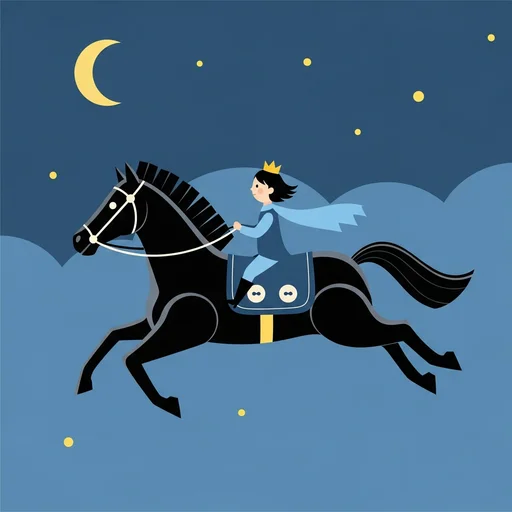
The Ebony Horse
On a bright festival day in Persia, the great king sat on his throne and received gifts from every land. Jewels glittered, silks shone, and dancers spun. Last of all came a wise man from India, leading a horse carved from shining black wood. It wore a golden saddle and had two small pegs set in its neck.
“This is my ebony horse,” said the wise man. “Turn one peg, and it will rise higher than the clouds. Turn the other, and it will come down where you wish. It can fly to the ends of the earth in a day.”
The courtiers laughed, thinking it a toy. But Prince Firouz, the king’s son, stepped closer, eyes bright. “Father, may I try it?”
“First, name your price,” the king told the wise man.
The man bowed. “Only one thing will pay for such a wonder: your daughter’s hand in marriage.”
The king grew angry. “You dare ask for my child?” He would have driven the man away, but Prince Firouz spoke quickly. “Let me see if the horse truly flies. Then we can decide.”
The wise man helped the prince into the saddle. “Turn this peg,” he said, touching one, “and pull the reins to steer.” He did not explain the other peg.
Prince Firouz turned the peg—and the ebony horse leaped into the sky. The palace, the city, and the fields flashed beneath him. The wind roared past his ears. Higher and higher he rose until he felt the cold of the clouds and saw the stars waking in the evening sky.
Below, the king cried out in fear and had the wise man thrown into prison. “Bring back my son,” he commanded, “or you will answer for it!”
Up among the clouds, the prince realized his danger. “I know how to rise,” he said to himself, “but how do I come down?” He tried the peg again—higher still! He tried the reins—he turned this way and that, but the horse only circled. At last he noticed the second peg the wise man had not mentioned. Carefully, he turned it—and the ebony horse began to sink, smooth as a swan on a lake.
Far below he saw lamps twinkling in a strange city. He guided the horse toward the brightest lights and, as night settled, landed on the flat roof of a grand palace. He set the horse against a wall like a statue and hid behind it.
When the moon rose, a door opened onto the roof. A young lady stepped out with her ladies to enjoy the cool air. She was the Princess of Bengal. Seeing the shape of the horse and the shadow of the prince, she gasped. “Who is there?”
Prince Firouz stepped forward, bowing. He told her honestly where he had come from and how the flying horse had brought him there. The princess listened, first surprised, then curious, then smiling. “You are far from home,” she said softly.
They talked until the stars turned pale. At last the prince said, “Princess, if you will trust me, come with me on the ebony horse. I will keep you safe and take you to my father, the King of Persia. Then I will return with gifts and ask your father for your hand in the proper way.”
The Princess of Bengal was brave and clever. She agreed. Together they mounted the ebony horse. The prince turned the first peg, the horse rose, and the city fell away beneath them. They flew over silver rivers and dark forests, the sea like a sheet of glass, mountains like folded blankets, until the sun climbed bright and warm.
By evening they reached Persia. Not wishing to surprise his father at night, the prince landed in a quiet summer palace by the gardens and settled the princess there with gentle ladies to serve her. “Rest,” he said. “At dawn I will fetch my father and ask his blessing.”
But fate tangled the threads. The king, returning from the hunt, wandered through the gardens and found the summer palace glowing with lamps. There he saw the Princess of Bengal, so lovely that he was struck with wonder. He did not know she was his son’s beloved. “Be my queen,” he begged.
The princess was wise. She bowed and spoke gently. “Great king, I am not well. I cannot wed until I am cured.” And because she would marry no one but Prince Firouz, she feigned madness—she cried at music, turned away from food, and would not wear fine clothes. The king called every doctor, but none could help.
In the dungeon the wise man from India heard of the king’s trouble. He sent a message: “Set me free and give me the ebony horse, and I will cure the princess.” Desperate, the king agreed.
The wise man was brought to the summer palace. “Princess,” he said smoothly, “your cure is simple. Sit upon the ebony horse in the garden. The fresh air will clear your mind.” She knew him at once and hesitated, but he moved quickly, leaped up behind her, turned the peg—and in a flash they were in the sky.
He flew to the kingdom of Cashmere and hid the princess in a palace, telling her she must now be his wife. She kept her courage. “Give me time,” she said. She sent a secret message to the King of Cashmere, telling him the truth. The king believed her, took her under his protection, and locked the wise man in prison. The ebony horse was kept in the royal stables, guarded day and night.
Meanwhile Prince Firouz hurried back to the summer palace and found it empty. He learned how the wise man had tricked the king and stolen the princess. Though his heart ached, he did not give up. He searched from city to city until he heard a marvel told in markets and caravan inns: in Cashmere there was a wooden horse that could fly and a foreign princess under the king’s care.
The prince disguised himself as a learned physician and went to the court of Cashmere. “I can cure sadness,” he said. The king brought him to the princess. One glance was enough. They knew each other, but they kept their joy hidden.
“My cure has two parts,” said Prince Firouz, bowing. “First, the patient must walk in a garden and feel the breeze. Second, she must sit upon the wooden horse to steady her heart, while I guide it across the lawn.”
The king, kind and curious, ordered the ebony horse brought out. The prince showed how it stood firm, how the saddle was safe, how the pegs were harmless when left alone. He helped the princess into the saddle, then sprang up behind her. He turned the secret peg—and before anyone could cry out, the ebony horse soared into the sky.
The people below shaded their eyes. The King of Cashmere stared in astonishment. But when messengers told him the stranger was the princess’s true beloved, and that the jailed wise man had been the trickster, he was content to let them go. The wise man, for his crimes, was punished and seen no more.
Prince Firouz and the Princess of Bengal flew straight to Persia and landed in the palace courtyard. The king ran out, amazed and ashamed. He begged the princess’s pardon and embraced his son. “I was wrong,” he said. “May you both forgive me.”
There were great celebrations. The prince married the Princess of Bengal with the blessing of both their fathers. The ebony horse was kept in a hall of treasures. Sometimes, on clear days, the prince and princess would ride it to watch the sunrise over rivers and mountains. And they never forgot that wisdom, courage, and patience had guided them safely home.
The end
