
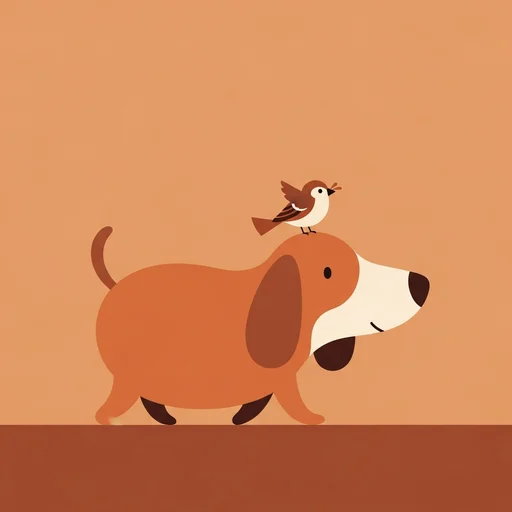
The Dog and the Sparrow
Once there was a man who owned a small brown dog. The man was hard and gave the dog so little to eat that the poor creature grew thin, weak, and sad. One morning, with an empty belly rumbling like a drum, the dog sighed, “I cannot live like this. I must go and seek my food in the wide world.” So he trotted out of the yard and down the road.
Not far along, a quick little sparrow fluttered down beside him. “Friend Dog,” chirped the sparrow, cocking its head, “why do you look so hungry and tired?”
“I am hungry because my master starves me,” said the dog. “I am leaving to look for something to eat.”
“Don’t worry,” said the sparrow. “I will help you. Come with me!” The sparrow flew ahead, and the dog followed as best he could.
They reached a town. The sparrow darted into a baker’s shop and pecked at a crust of bread until a good piece fell to the floor. “There, eat that,” it chirped. The dog gobbled it gratefully. Then the sparrow flew to a butcher’s stall and tugged at a slice of meat, working and pecking until it slipped from the hook. Down it dropped, and the dog ate until he felt strength return to his legs and a little warmth to his heart.
“Thank you,” said the dog, wagging his tail. “You have saved me.”
“We are friends now,” the sparrow replied. “Come. We will walk together.”
So the dog and the sparrow set out along the country road. The sparrow rode awhile on a fence, then on a milestone, and then on the dog’s back, singing little songs to keep his friend company. Before long, they heard wheels rattling and saw a wagon coming, heavy with barrels, pulled by strong horses and driven by a rough wagoner.
The sparrow flew up and called, “Wagoner, slow your horses! My friend is small and weak. Do not hurt him!”
But the man cracked his whip and shouted back, “Out of the way! A dog like that is nothing to me.” The sparrow cried out again, “Hold hard, or my dog will be crushed!” Yet the wagoner drove straight on. The poor dog could not leap aside in time. The great wheels rolled over him, and he lay still.
The sparrow circled once above his friend, then hovered in front of the wagoner’s face. “You have killed my dog,” it said in a clear, cold voice. “For this, you shall lose your riches and become poor.”
The wagoner only laughed and flicked his whip. But the sparrow flew to the first barrel, pecked out the wooden peg, and the red wine came whispering out, first a trickle, then a steady pour. “Hey!” shouted the wagoner. “Stop that!” He grabbed an axe and swung it at the sparrow. He missed. His axe struck the side of the barrel. Crack! The wood split, and the wine rushed out in a river across the road.
The sparrow hopped to the next barrel, popped out its peg, and again the wine began to run. The wagoner, angrier than before, swung and smashed, and soon his own blows had ruined every cask. The road smelled sweet with wine, but the wagoner had none left to sell.
“You bird of bad luck!” he cried. “I will be rid of you yet!”
The sparrow perched on the head of a horse. “Hit me, if you dare,” it said. The wagoner raised his axe and struck. The sparrow flicked aside, and the blow fell on the good horse. Down it went. The sparrow landed upon a second horse. The wagoner, blind with rage, struck again, and the second horse fell. The sparrow lit upon the third, and once more the axe came down. When the dust settled, all three horses lay still, and the wagon stood useless in the road.
“Now you have no wine and no horses,” the sparrow said. “Remember my friend.”
The wagoner stumbled home on foot, hot with fury and shame. “Wife!” he cried as he burst into his yard. “A wicked sparrow has ruined me. Help me catch it!” Just then, the sparrow alighted on the roof and chirped as if laughing. The wagoner flung a stick. Smash went the tiles, but the bird winged safely to the window.
“Quick, close the shutters!” shouted the wife. She threw them shut, but the sparrow slipped through and fluttered into the kitchen. “There it is!” cried the wagoner. He swung his axe at the bird upon the shelf. Crash went the jars. Then the sparrow sat on the stove. The axe came down. Crack went the stove. The sparrow perched on the cupboard. The axe followed. Clatter went the plates.
“Stop! You will break the whole house,” the wife pleaded. But the man would not listen.
The sparrow flew to the cradle where their little child lay. “Away from there!” shouted the wagoner. He rushed forward and struck. The sparrow sprang up, and the cradle splintered. Their child was struck and hurt so badly that it never breathed again.
The mother cried out, and the wagoner froze. For a heartbeat the house was terribly quiet. Then, with grief twisting into anger, the man swore, “I will have that bird, even if it costs my life.” He watched and waited. When the sparrow at last settled close, he snatched and caught it fast in his hand.
“Now I have you,” he said, his voice rough. “You shall not escape me again.”
“Do as you think best,” chirped the sparrow, very calm.
“I’ll swallow you whole,” the wagoner growled. “Then you can do me no more harm.” He opened his mouth wide and gulped the sparrow down.
For a moment all was still. Then a tiny head popped up between his lips. “Peep! Peep!” mocked the sparrow. The wagoner clapped a hand over his mouth, but the bird peeped out again, bright-eyed and bold.
“Wife!” he cried, muffled. “Bring the axe. Strike the bird when it sticks out its head. Strike true, and this will end.”
The wife, pale and shaking, lifted the axe. The sparrow peeped, “Here I am.” The wife swung—once, hard—and missed the bird. Her blow fell upon the wagoner. He dropped to the floor and did not move again.
The axe thudded to the ground. The wife stood, shocked and silent. Then the sparrow fluttered free from the wagoner’s mouth and out through the broken window, into the open air.
That is how the sparrow kept his promise to the friend who had been kind to him, and how anger and cruelty brought a hard man to ruin. Those who take care should be taken care of. Those who trample others may stumble themselves.
The end
