
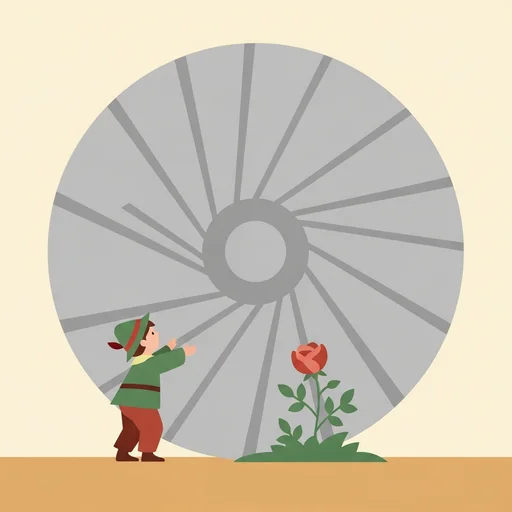
The Devoted Friend
By the river, a Water-Rat liked to boast. "I know all about friendship," he said, flicking his whiskers. A Duck paddled past and chuckled. A little Linnet, bright as a leaf in spring, perched on a reed. "Shall I tell you a story about a devoted friend?" the bird asked.
"Is it long?" grumbled the Water-Rat. "It has a clear beginning, a middle, and an end," said the Linnet. "And it will show what true friendship is." The Water-Rat settled down, and the Linnet began.
Once there was Little Hans, a kind gardener who grew the loveliest flowers. He had a tiny cottage and a small garden filled with roses and tulips and sweet-smelling herbs. Across the road lived the Miller, a rich man with a big mill, a big voice, and big ideas about friendship. "Good morning, Little Hans!" the Miller would cry. "How lucky you are to have such beautiful flowers! I am your best friend, so I will help you by taking a bunch to my wife. She loves flowers." And without waiting for a yes or no, the Miller would cut the finest blooms and carry them away.
Hans smiled because he was gentle and wanted to please his friend. He lived by selling his flowers, but he never complained. In summer and autumn, the Miller visited often and spoke grandly. "Real friends share everything," he said, always with a pocket full of Hans's roses. In winter, though, the garden slept, and Hans had no flowers to sell and not much to eat. Snow piled on his roof. His boots were thin. The Miller, snug by his fire, told his wife, "I will not visit Hans now. If I went, he might ask me for flour or firewood, and that would put him in a false position. It is better for him that I stay away. A true friend must never embarrass a friend."
When spring came and the first crocus shone like a tiny lantern, the Miller arrived with a smile as wide as the mill-pond. "Dear Little Hans!" he cried. "How well you look! I have been thinking of you all winter. Friendship is a wonderful thing. To prove mine, I will give you my old wheelbarrow. It's a bit broken on one side, but still very useful."
Hans clapped his hands. His own wheelbarrow had fallen apart the year before. "Thank you!" he said. "I need it for my garden."
"Of course," said the Miller grandly. "But friendship means doing things for each other. Before I bring the wheelbarrow, could you carry this sack of flour to market for me? My back is delicate today. True friends are always ready to help."
Hans lifted the heavy sack and trudged to town. He got tired, but he thought of the wheelbarrow and kept going. The next day the Miller returned. "My barn roof leaks," he said. "You have some planks in your shed. It would be unfriendly of you to keep them when I need them. Give them to me, and I will mend the roof."
Hans had saved those planks to fix his own roof, but he nodded. "If it helps, take them."
"How generous!" said the Miller. "I see you are truly devoted. As for the wheelbarrow, one wheel is missing, but you can easily mend it. By the way, I need you to watch my sheep on the hill. The grass is good there, and you are such a careful person."
Hans looked at his garden. "If I go, my flowers will wilt."
"How unkind to speak so!" cried the Miller. "I am giving you my wheelbarrow, and you refuse a small favor? Besides, tending sheep will teach you patience. That is a gift, too."
So Hans led the sheep to the hills and stayed with them while his own garden grew wild with weeds. He felt tired, and sometimes he was hungry, but when the Miller praised him, he tried to feel proud.
One night, when clouds covered the moon and rain fell hard, there came a furious knocking at Hans's door. He opened it to find the Miller, dripping wet.
"Little Hans!" shouted the Miller. "My little boy is very ill. Run for the doctor at once! I would go, but the night is dreadful, and I am thinking of my wife. Besides, you are so devoted."
Hans wrapped himself in his thin coat and hurried out into the storm. The wind pushed him, and the rain blinded him. He reached the town and woke the doctor. "Please come," Hans begged. "The Miller's boy is sick."
They set out together, the doctor's lantern bobbing in the dark. On the narrow bridge by the mill-pond, the wind roared like a beast. Hans, cold and dizzy, slipped. The lantern light swung, the doctor cried out, and Hans tumbled into the deep, black water. The river swallowed his voice, and he did not come back.
The doctor and the Miller reached the house at last, but there was nothing they could do for Hans. In the morning, the sun rose, shining on a quiet pond and a cottage with an empty chair. The whole village came to Little Hans's funeral. The Miller was the first to speak. He wiped his eyes and said, "Hans was my best friend. He was devoted to me. I had even planned to give him my old wheelbarrow. Now I have no one to give it to. It is very sad for me."
The Linnet fell silent. The rushes whispered in the breeze.
"And the moral?" demanded the Water-Rat. "Every good story must have a moral just for me."
"It is simple," said the Linnet gently. "True friends do not only take. They give help when help is needed. Words are not enough; kindness must be real."
The Water-Rat twitched his whiskers. "I see no moral at all," he snapped. "The story is about a foolish gardener who should have thought of himself more. As for me, I shall go back to my hole." He slapped the water with his tail and swam away.
The Duck laughed softly and fluffed her feathers. "Some creatures," she said, "do not understand stories—or friendship." The Linnet sang a small, sad song, and the river went on, bright and clear, carrying the tale to anyone willing to listen with an open heart.
The end
