
Puss in Boots
Once upon a time, a miller died and left his three sons what little he had: to the eldest, the mill; to the second, the donkey; and to the youngest, only the cat. The youngest son sighed. “What can I do with a cat?” he wondered. “My brothers can work, but I will surely starve.”
The cat, who was no ordinary cat, hopped onto a chair, curled his whiskers, and spoke. “Do not worry, master,” he said. “All I ask is a strong bag with a drawstring and a pair of boots to keep my paws from thorns. Then you shall see that you have not received the worst share.”
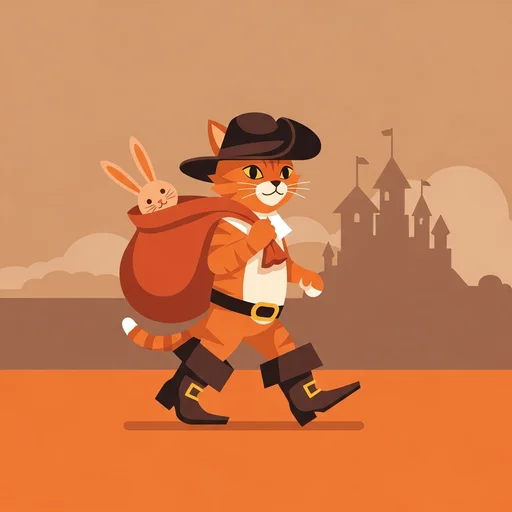
The young man was amazed that his cat could talk, but he sold his last small bundle of flour to buy a neat little bag and a tiny pair of shiny boots. The cat pulled on his boots, slung the bag over his shoulder, and went to the woods. He put bran and lettuce in the bag, laid it open on the ground, and hid behind a bush. Soon a foolish young rabbit hopped right in. Quick as a wink, the cat drew the strings tight.
Puss in Boots (for that is what we must now call him) marched straight to the king’s palace and bowed low. “Your Majesty,” he purred, “a gift from my master, the Marquis of Carabas.” The king, who had never heard of such a marquis but liked presents very much, thanked the cat and ordered a coin for the messenger.
The next day, Puss set his bag by a wheat field. A plump partridge pecked its way inside. Again the cat pulled the strings and took the bird to the king. “From my master, the Marquis of Carabas,” he said. Day after day Puss brought game—rabbits, partridges, even a fat young hare—and always in the name of the Marquis of Carabas. The king began to speak often of this generous marquis, and the princess smiled to think how kind he must be.
After a time, Puss learned that the king and his daughter would be riding by the river in their carriage. He hurried home to his master. “If you will do exactly as I say, your fortune is made,” he promised. “Go and bathe in the river at the place I shall show you, and leave the rest to me.”
The young man, who trusted his clever cat by now, went with him to the riverbank. As soon as he stepped into the water, Puss hid his master’s old clothes under a big stone. Just then the royal carriage rolled by. Puss ran out into the road, waving his arms. “Help! Help!” he cried. “My master, the Marquis of Carabas, is bathing and has been robbed of his clothes!”
The king looked out the window and recognized the cat who so often brought him gifts. “Stop the carriage!” he commanded. “Guards, fetch the marquis at once!” The young man was drawn from the water and wrapped in a fine cloak. The king ordered a splendid suit to be brought from the palace. When the young man put it on, he looked handsome indeed. The princess glanced at him and blushed. The king invited this polite and grateful “Marquis of Carabas” to ride with them.
Meanwhile, Puss in Boots ran ahead as fast as his boots could carry him. He came upon some mowers cutting grass. “Good people,” he called, “the king will pass here soon. If he asks whose meadow this is, say it belongs to the Marquis of Carabas, or you will be very sorry you did not.” The mowers, surprised to hear a cat speak and seeing his fierce green eyes, nodded quickly.
A little farther on, Puss met reapers binding wheat. “Friends,” he said briskly, “the king is coming. If he asks whose fields these are, you must answer, ‘The Marquis of Carabas.’ If you do so, all will go well.” Remembering the sharp warning of the cat, they agreed.
As the royal carriage rolled by the meadow and the fields, the king called out, “What fine hay! What golden wheat! To whom does all this land belong?” “To the Marquis of Carabas, Your Majesty!” the workers cried. The king turned to the young man with admiration. “You are a great lord indeed,” he said. The young man bowed modestly, for he did not yet know what his clever cat was planning.
At last Puss in Boots came to a grand castle, the finest in the region. It belonged to a fearsome ogre who owned all the lands the cat had just passed. The ogre was rich, powerful, and proud, and it was said he could change himself into any creature he pleased. Puss straightened his boots, brushed his fur, and knocked politely. “Good day, my lord ogre,” he said with a graceful bow. “I have heard much of your greatness. They say you can become a lion or an elephant in an instant. Is it true?”
The ogre, who loved to show off, roared, and in a flash became a lion with a mane like fire. Puss leaped backward and scrambled up the nearest curtain to keep his whiskers safe. “Marvelous!” he cried from the curtain rod. “You are as mighty as the stories say! But surely you cannot turn into something very small—a rat, for example, or a mouse. That would be far too difficult.”
“Too difficult?” bellowed the ogre, now himself again. “Watch me!” In a blink he shrank and became a tiny gray mouse that scurried across the floor. Quicker still, Puss in Boots dropped lightly down, pounced, and—snap!—the ogre was no more. Puss brushed off his paws, then threw open the castle gates.
Just then the king’s carriage arrived at the grand doors. Puss ran to the steps and bowed low. “Welcome, Your Majesty, to the castle of the Marquis of Carabas,” he declared. The servants, who had belonged to the ogre, dared not argue when they saw the king, and they hurried to set out the feast that had been prepared for their former master.
The king admired the shining halls, the long tables, and the view over the meadows and fields—all of it the finest he had ever seen. “Marquis,” he said, “you have a beautiful estate.” The young man smiled, though his heart beat fast at the wonder of it all. He escorted the princess to the table. She had found his conversation gentle and his manners pleasing, and now she liked him more than ever.
After a merry meal, the king, delighted by the day and charmed by the supposed marquis, turned to his daughter. “What think you of the Marquis of Carabas?” he asked. The princess lowered her eyes and replied, “I think he has a good heart.” And so, with the king’s blessing, the young man and the princess were soon married.
Puss in Boots became a great lord in the new household. He wore fine clothes, walked where he pleased, and hunted mice only for his own amusement now and then. As for the young man, he never forgot that cleverness and courage can change one’s fortune—and he never forgot to keep Puss’s boots brushed to a sparkling shine.
And if ever someone asked how it all came to be, Puss would purr and say, “It began with a bag, a pair of boots, and a little bit of cleverness.”
The end
