
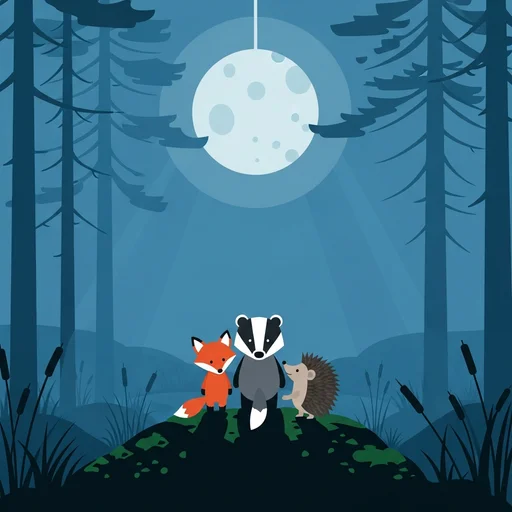
Night's Song
When the moon cast silver over the marsh and the shadows of the pines became long as whispers, a low humming began to fill the air. It came from nowhere and everywhere at once, as if the night itself sang through straw and reed. The small animals crawled deeper into their dens, but three friends perked up their ears and eyes: the fox cub Loke, the badger Maj, and the hedgehog Vilda.
“Do you hear?” said Loke, letting his ears quiver. “It sounds like a giant’s belly.”
“Or like when the wind gets stuck,” answered Maj, tasting the scent in the ground. She was slow but clever, with paws that could feel what the earth knew.
Vilda gently pushed aside a leaf with her nose. She was small but brave, and her spines glittered like star spikes. “If we figure out what it is, maybe the little ones will dare to sleep. I can’t count myself tired when it hums like that.”
The three friends sealed their silent agreement there by the stump: they would follow the sound to its source, however far it carried them over the marsh’s soft heart. Loke would listen with his finest hearing, Maj would read the tracks in the clay, and Vilda would remember the way home.
They padded out. The night’s air was cool and smelled of resin, moisture, and something entirely its own, a quiet tension that tickled the whiskers. Glowworms blinked deep within the grass, as if someone had scattered small lamps on the ground. The beaver’s canal lay like a dark band between the tussock islands, and each step had to be placed carefully. Loke wanted to rush, but quickly learned that the marsh liked kindness, not speed.
“Small steps, Loke,” said Maj, placing her broad paw on a firm tussock. “Don’t just listen to the sound. Feel how the ground responds.”
“I’m counting,” said Vilda, taking one marsh step at a time. “One, two, three... Spines pointing the right way.”
The humming changed. Sometimes it deepened like a sleeping bear’s sigh, sometimes it rose and became bright as a fly in a window. They followed the vibrations, as if they were threads to hold on to. One time Loke’s paw slid down between grass tussocks and cold marsh water sucked at him, but Maj was there, heavy and steady, and pulled him up with a chuckle.
“Thanks,” said Loke, shaking water drops from his tail like diamonds. “I’ll go with ears first and paws second.”
The sound led them to an alder with roots clinging to the edge of a stream. The wind whistled through the branches, but the humming was strongest down by the ground, where the roots formed a small cave. Loke pointed with his nose. “In there!”
They crept closer and saw something gleam faintly in the moonlight. A glass bottle lay wedged between the roots. The wind slipped past the bottle neck and made it into a giant shell; it sang. But it wasn’t just the wind. Inside the bottle, among water drops and a tangled, glossy thread, something dark trembled.
“Wait,” whispered Maj. “It’s alive.”
It was a bat, small as a hand but with wings that folded like night’s own cloak. One leg was caught in a thin fishing line that had cut into the skin. Each time it tried to rise, the wing hit the glass with a pitiful ping.
Vilda held her breath. “It’s scared. And I am too, a little. But together we’re bigger than the fear.”
Maj nodded. “We must be both gentle and wise now. The glass is hard, the thread sharp, and the bat fragile.”
They made a plan. Vilda was smallest and could get closest without blocking the opening. Maj, who had the strength, would hold the bottle steady so it wouldn’t roll. Loke, with his narrow nose and eyes that saw details even in twilight, would grab the thread with a sharp reed straw he picked by the stream.
“Breathe slowly,” whispered Vilda to the bat, meeting its glittering, black eyes. “We are friends.”
Maj pressed the bottle down into a bed of clay so it stayed still. The humming grew stronger from all their closeness, but they let it be, like a strong heartbeat. Loke carefully inserted the reed straw, bent it under the thread, and lifted. He felt how it sank into the thread, how every small movement meant something. Vilda held the wing so it wouldn’t strike, softer than a cloud. It took time. The wind swayed and mosquitoes sang their own small songs, but the friends didn’t let go of their task.
Suddenly the thread gave way. The thin line released its grip with a quick, light thud, and the bat sucked air into its body like a sail filling with wind. The humming fell silent when the bottle was rolled slightly aside and the wind no longer hit exactly right.
The bat stayed for a moment, trembling. “Thank you,” it peeped with a voice so thin that only night and friends could hear. “I flew after the moon and got caught in humans’ forgotten string. I thought night’s song was my last.”
“Night’s song is also a call for help sometimes,” said Maj, smiling so it showed in her eyes. “We listened.”
The bat stretched its wings. They gleamed like polished leaves in the moonlight. With a swirl around their heads, it lifted. “I’ll tell the wind that you’re good to have,” it peeped before it disappeared like a wisp of smoke toward the stars.
The friends stood and breathed. The forest sang now in its usual way: an owl’s calm hooting, a stream laughing quietly, far away a fox calling its shadow. Loke rolled the empty bottle between his paws.
“This doesn’t belong here,” he said. “How do we silence it forever?”
“We do like the beaver,” said Vilda. “He takes care of things that disturb the water.”
They carried the bottle, heavy with tiredness but light in heart, along the beaver’s canal. At the lodge they met the beaver’s own broad, shiny nose.
“Oh,” said the beaver, receiving the glass with both hands. “Humans forget these kinds of things. I’ll bite apart the thread and hide the glass until humans take it to their big metal wagon that collects and makes new. You did well.”
On the way home, the marsh was kind. Tussock by tussock, it carried them back. Loke no longer walked first; he walked alongside. Maj hummed her own, warm tune, and Vilda no longer counted spines but stars.
When they reached the stump, morning was just a light behind the trees. They lay close to each other and let sleep come, with the night’s scents still in their fur and a quiet song in their chest.
And if anyone wondered what they learned, they would have said this: Courage is walking together. Fears become smaller when you listen carefully. And every night carries a story, but some stories can be changed if you just want to help.
The end
