
Asbjørnsen and Moe
Boots and the Troll
Once upon a time, in a little farmhouse at the edge of a deep, dark forest, there lived a poor man and his three sons. The two eldest were strong and handy. The youngest was called Boots. He was the one who sat by the hearth and poked the ashes, and everyone thought he was slow and dreamy. Still, he listened and watched, and his eyes were bright.
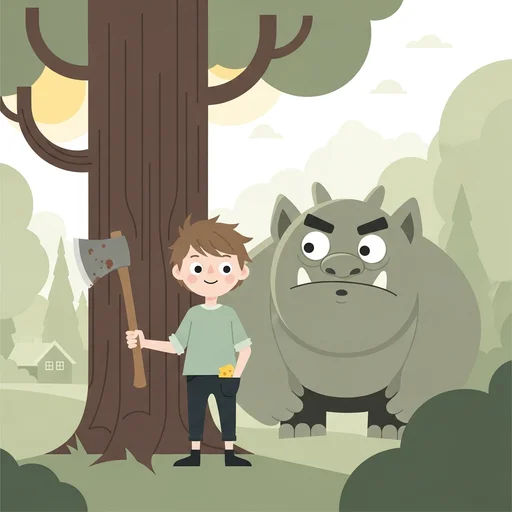
Beyond the farm lay a patch of fine timber that could have made the family rich. But no one dared cut it. A troll who lived in the woods roared and raged whenever anyone raised an axe, and he chased them off before they could take a single log home.
One day the father said, “We must have wood, or we’ll freeze in winter.” The eldest son took his axe and set off to the forest. He had hardly begun to chop when the troll burst from behind the firs, eyes glowing and voice like thunder. “This is my wood,” the troll bellowed. “If you touch a single tree, I’ll tear you to bits like straw!” The eldest son dropped his axe and ran for his life.
The next day the second son tried. He held his axe a little tighter, but he, too, had only struck a few chips when the troll stomped out and roared. “This is my wood! Be off, or I’ll make kindling of you!” The second son, who had less breath than his brother but no more courage, ran as well.
On the third day Boots stood up from the hearth. “Let me go,” he said. His father sighed. “You? Why, you’re only good for warming the ashes.” But Boots smiled and begged until his father gave him an old axe. Boots tucked a piece of cheese into his pocket and went off whistling.
He found a stout tree and began to chop. Chip, chop! The forest rang. Then the troll came, snapping branches under his great feet and snarling, “This is my wood! Stop, or I’ll smash you like a beetle!”
Boots didn’t run. He reached into his pocket, pulled out the cheese, and held it up as if it were a stone. “Smash me?” he said. “Hmph! Do you see this stone? If you don’t mind your manners, I’ll squeeze water out of it—and I’ll squeeze worse out of you.”
Before the troll could laugh, Boots squeezed the cheese in his fist. Whey ran down between his fingers. The troll’s eyes bulged. “He can squeeze water out of a stone,” the troll mumbled, stepping back. “Perhaps we can be friends.”
“Very well,” said Boots. “Let’s see how strong you are at work. Help me fell this tree and carry the logs.”
So the troll worked, and Boots worked, though Boots was careful with his strokes. The troll tugged and hauled until sweat rolled down his nose. “You carry a fair bit for a small fellow,” the troll puffed.
“I could carry more,” said Boots, “but I mustn’t overdo it. I’d hate to squeeze a rock and flood your forest.” The troll swallowed and said no more.
When the sun slid low, the troll scratched his head. “Come to my place and eat,” he said. “Anyone who works in my wood deserves supper.”
“Gladly,” said Boots.
They came to the troll’s cave, wide-mouthed and smoky. The troll set a great pot on the fire and stirred a mountain of porridge. “Let’s see who can eat the most,” he grinned, licking the spoon. “Win, and you may take home whatever you like from my hoard.”
Boots looked at the cauldron and at the troll’s belly and quietly set to work with his own plan. While the troll stirred, Boots slipped a stout bag under his shirt and tied the mouth of it snug at his neck, so it hung like a round belly under his coat.
“Ready?” roared the troll.
“Ready,” said Boots.
They ate. The troll scooped porridge by the bowl. Boots shoveled porridge into his mouth—and most of it went down into the hidden bag. The troll huffed and puffed and kept on eating. Boots smiled and patted his false belly, which swelled and swelled.
At last the troll groaned, “Uff! I can’t eat another spoonful.”
“I can,” said Boots cheerfully, “but there’s a trick to it. When I get full, I just cut a little hole to make room for more.” He took his knife and, with a quick slice, cut a slit in the bag under his shirt. Out poured the porridge, splashing on the floor behind him where the troll couldn’t see. Boots sighed as if it were the easiest thing in the world. “There! Now I can go on forever.”
The troll stared, amazed. “If that’s how you do it, I’ll do the same!” he cried. “I must win my own contest.” Before Boots could blink, the troll snatched up a knife and jabbed it into his belly.
That was the end of the eating match—and of the troll. With a crash and a groan, he fell to the floor and moved no more.
Boots stood very still and listened. The fire crackled. The cave was quiet. Then he looked around. In the shadows, he saw chests piled high with silver and gold, ropes and tools, and fine new axes gleaming on the wall.
“Father will have wood enough now,” Boots said softly.
He took as much treasure as he could carry and slung the best axe over his shoulder. Then he went back to the farm by starlight, laughing to himself at the night owls and their questions.
When Boots stepped in the door, his brothers’ eyes went wide. His father’s jaw dropped. Boots poured out bright coins on the table till they glittered like a little sun. “Where did that come from?” cried the brothers.
“From the forest,” said Boots. “And there’s no troll left to block us. Tomorrow we’ll cut the trees and bring them home. We’ll be warm in winter, and we’ll mend the roof before the first snow.”
And so they did. The next morning, with the new axe flashing, they felled the tall pines and dragged home straight logs till the woodpile stood higher than the barn door. The father looked at Boots and shook his head in wonder. “I thought you were only good for the ashes,” he said, “but you had more in you than smoke.”
Boots just grinned, poked the hearth, and kept his secret. After that, whenever anyone asked how they managed, the brothers would point at the stack of wood and say, “Brains beat brawn, and courage beats roaring.”
The farm was never cold again, and Boots was no longer the boy nobody noticed. If ever he passed the edge of the forest, he’d squeeze his empty hand and chuckle, remembering the cheese, the porridge, and the boast that scared a troll.
The end
